


Eco Tech Electrical Contractors limited

Skip to content

Fire alarm testing · London-wide coverage

Fire Safety Certificate in London

Professional fire alarm testing for landlords, HMOs, homeowners and businesses. Clear documentation, qualified engineers and practical appointment options across London postcodes.

  • From £69.99
  • All inclusive pricing
  • No upfront payment
  • Certificate target within 24 hours

Clear fixed pricing · Qualified inspection · No hidden charges

Fire alarm testing

Choose your fire alarm testing service

Clear prices for common systems, with no hidden charges. Larger or more complex buildings receive an accurate quote from our engineer.

Mains Smoke Alarm 1-3

£69.99*

All Inclusive (No Hidden Charges)

Mains Smoke Alarm 4-6

£79.99*

All Inclusive (No Hidden Charges)

Mains Smoke Alarm 6-12

£89.99*

All Inclusive (No Hidden Charges)

Fire Alarm Panel Up to 12 Points

£99.99*

All Inclusive (No Hidden Charges)

Large or Complex Buildings

Speak to our engineer for a free, accurate quote tailored to your fire alarm system.

Call now
4.9
62 Reviews
google
Jan Du
Jan Du
5.0
16/10/2026
google
DG Family
DG Family
5.0
06/10/2026
google
Narojan Amirthalingam
5.0
29/09/2026
google
Foisal
Foisal
5.0
24/09/2026
google
fariba mavaddat
fariba mavaddat
5.0
20/09/2026
google
Graham Storey
Graham Storey
5.0
09/09/2026
google
Amy
Amy
5.0
08/09/2026
google
Ionut Bilibou
Ionut Bilibou
5.0
08/09/2026
google
Chaitanya Joshi
Chaitanya Joshi
5.0
07/09/2026
google
Nate n
Nate n
5.0
28/08/2026
google
iirth events
iirth events
5.0
27/07/2026
google
Lily Liu
Lily Liu
5.0
25/07/2026
google
Jim Males
Jim Males
5.0
14/07/2026
google
Lavarinthan Joseph Justeen
5.0
07/07/2026
google
kam teo
kam teo
5.0
07/07/2026

Fire alarm testing you can rely on

Why Choose Eco Tech Electrical?

Your fire alarm certificate is part of your property's safety record. We keep the process clear, professional and focused on what landlords, tenants and Responsible Persons actually need.

  • NICEIC Approved ContractorInspection and testing carried out by a properly assessed electrical contractor.
  • Fully Qualified ElectriciansCompetent engineers who understand panels, detectors, sounders and battery backup systems.
  • Council-Aware ServiceClear documentation to help you keep your landlord, HMO or commercial safety records organised.
  • Same-Day and Next-Date AppointmentsChoose a practical appointment window and keep your compliance work moving.
  • Clear, Fixed PricingSee the available service price before you book, with no unnecessary upfront payment.
  • Fire Alarm Certificates Within 24 HoursReceive your testing documentation promptly after the inspection is completed.

Service availability and report timing depend on property access, system condition and the scope of testing.
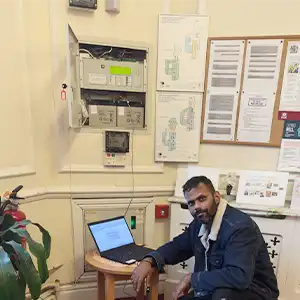
Engineer carrying out electrical and fire alarm inspection work
Safety
first

Simple from booking to report

Fast & Hassle-Free Fire Alarm Testing

No confusing steps and no unnecessary delays. Choose a convenient appointment, let our engineer complete the testing, then receive your report clearly and promptly.

STEP 01

Book online or call us

Choose a date and time that suits your schedule, and we’ll confirm your appointment clearly.

STEP 02

Engineer attends on time

Our qualified team arrives when expected, keeps the visit efficient, and respects your time.

STEP 03

Inspection and testing completed

We check the fire alarm system, panel, devices, battery backups and key operational checks.

STEP 04

Receive your report

Your testing documentation is sent clearly and promptly once the inspection is complete.

From testing completed to certificate delivered Our process keeps things moving so your certificate is delivered quickly and clearly.
Testing CompletedInvoice RaisedPayment ConfirmedCertificate Sent
Your Fire Alarm Certificate Delivered Within 24 Hours

Clear process. Qualified engineers. No unnecessary waiting around.

Need help choosing the right appointment or checking the best testing window for your property? Speak directly to our team.

📍Areas We Cover

Electrical and fire safety compliance across all 30 London boroughs.

  • Barking & Dagenham
  • Barnet
  • Bexley
  • Brent
  • Bromley
  • Camden
  • Croydon
  • Ealing
  • Greenwich
  • Hackney
  • Hammersmith & Fulham
  • Haringey
  • Harrow
  • Havering
  • Hillingdon
  • Hounslow
  • Islington
  • Kensington & Chelsea
  • Kingston upon Thames
  • Lambeth
  • Lewisham
  • Merton
  • Newham
  • Redbridge
  • Richmond upon Thames
  • Southwark
  • Sutton
  • Tower Hamlets
  • Waltham Forest
  • Westminster

We also cover nearby areas outside London — contact us to confirm.

Kentec Fire Alarm Programming & Fault Finding — Real Emergency Call Out (IG11)

Fire alarm testing London

Professional Testing for Every Fire Alarm System

Fully compliant testing for Grade A, addressable, conventional and Grade D systems, delivered by qualified engineers for landlords, businesses, HMOs and mixed-use properties.

Who we help

Practical fire safety support for the buildings and people who rely on dependable alarm systems.

Landlords, HMOs and letting agents

Keep testing records, certificates and maintenance information ready for tenants, licensing and inspections.

Commercial buildings

Testing for offices, shops, warehouses, restaurants and larger premises with more complex fire risks.

Residential and mixed-use properties

Support for residential blocks, flats above commercial premises and properties with shared fire systems.

What is included in a fire alarm test?

We check the key parts of the system and explain any findings clearly.

✓Detector sampling Testing a representative minimum of 40% where applicable.
✓Alarm outputs Manual call point and sounder activation checks.
✓Power and batteries Supply, standby battery and panel condition checks.
✓Fault review Identification of faults and practical recommendations.
✓Records updated Fire logbook and maintenance records updated where available.
✓Digital certificate Clear testing documentation issued after the visit.
✓Emergency lighting BS 5266 compliant testing and installation options for protected escape routes.

Keep your safety records inspection-ready

A digital fire logbook helps record weekly tests, faults, maintenance, certificates and engineer visits. If you do not have one, we can provide a free digital logbook and explain how to maintain it.

Freedigital logbook
BS 5839aligned testing

Understanding fire alarm grades

The correct system depends on the building, occupants, layout and fire risk assessment.

Grade A systems - commercial and larger residential

Often used in HMOs, commercial buildings, offices, shops, warehouses, hotels and larger residential blocks.

  • Control panel
  • Detectors and sounders
  • Manual call points
  • Emergency interfaces where required

Grade D systems - domestic properties

Commonly used in houses, flats, smaller HMOs and domestic areas of mixed-use buildings.

  • Interlinked smoke and heat alarms
  • Mains-powered or battery-powered options
  • Regular user testing and maintenance
  • Requirements may be stricter for HMOs

How long does fire alarm testing take?

We plan the visit around your building to minimise disruption to staff, tenants and customers.

20-40 minSmall HMO
45-90 minMedium property
1-3 hoursLarge commercial
LongerAddressable data extraction

Why regular testing matters

Testing supports the fire safety strategy and helps identify problems before they become emergencies.

Compliance and licensing

Support your duties under the Regulatory Reform (Fire Safety) Order 2005, BS 5839 guidance, HMO licensing requirements and relevant insurance conditions.

Early fault detection

Find weak batteries, contaminated detectors, panel faults and unreliable sounders before the system is needed.

Fair, transparent pricing

Fixed options for HMOs, competitive commercial rates, multiple-property discounts and no hidden charges.


All inspections & installations follow official NICEIC safety standards.


Read more on the NICEIC website

Not Sure What You Need?

Tell us about the property and we’ll advise which inspection or certificate applies.


Speak to a NICEIC Approved Electrician

Explore Our Compliance Case Studies

Real-world inspections, upgrades, and risk assessments completed across London.


View Case Studies

Commercial fire alarm servicing guidance

Fire Alarm Testing & Servicing FAQs

Clear, practical answers for businesses, landlords, HMOs and Responsible Persons managing fire alarms, emergency lighting and compliance records.

15 questions

Servicing, testing and certificates

01Is fire alarm servicing a legal requirement for businesses?

Yes. Under the Regulatory Reform (Fire Safety) Order 2005, the Responsible Person must maintain suitable fire precautions, including a working fire alarm system where one is required. Regular servicing helps show that the system is maintained and operating correctly.

Servicing should follow BS 5839-1 where applicable and be carried out by a competent fire alarm engineer.

02How often do fire alarms need to be tested and serviced?

Typical arrangements include:

  • Weekly testing: by the Responsible Person or nominated person.
  • Six-monthly servicing: by a competent engineer.
  • Annual inspection: as part of the maintenance programme.

High-risk sites such as restaurants, takeaways, basements and care homes may need more frequent checks based on the risk assessment and system requirements.

03Why should I service my fire alarm system regularly?

Regular servicing helps reduce false alarms, extend system life, identify faults early, support compliance and reduce the chance of expensive emergency repairs. A maintained system is more likely to perform when occupants need it.

04What happens if I do not service my fire alarm system?

Detectors can become contaminated, batteries can weaken and sounders or control equipment can deteriorate. This can lead to false alarms, system failure, insurance complications, enforcement action and greater risk during a real fire.

05What fire safety certificates are required for commercial buildings?

The documents depend on the building, systems and risk profile. They may include:

  • Fire alarm service certificate.
  • Emergency lighting test certificate.
  • Fire extinguisher service certificate.
  • Fire risk assessment report.
  • Commercial EICR.
  • PAT testing report.

Keep relevant records available for inspections, insurance renewals and licensing applications.

06Do you provide certificates after servicing?

Yes. A service visit should produce a clear digital record confirming the work completed, system condition, recommendations and relevant compliance observations. Keep the certificate with your fire log book and maintenance records.

Emergency lighting and system selection

07Do commercial properties need emergency lighting?

Many commercial premises require emergency lighting under BS 5266-1, depending on layout, occupancy and escape arrangements. This can include offices, shops, restaurants, warehouses, HMOs, schools and care homes.

Typical maintenance includes a monthly function test and an annual full-duration test, with records retained.

08How do I know what grade of fire alarm system my building needs?

The decision depends on building layout, floors, basements, commercial kitchen activity, flats above and occupancy type. If you are unsure, ask the local council or request a Fire Risk Assessment before installing a system. This reduces the risk of paying twice for the wrong design.

09Can I upgrade my existing fire alarm system?

Many older systems can be upgraded, depending on their condition, compatibility and the building's current requirements. An upgrade may improve reliability, coverage, compliance and ease of maintenance. A competent engineer should assess the existing system before recommending options.

10Do domestic properties need fire alarm servicing?

Domestic Grade D systems do not usually require the same formal servicing programme as commercial systems, but regular testing and maintenance are recommended. HMOs and other higher-risk residential properties may have stricter requirements under council licensing conditions.

11What is the difference between domestic and commercial fire alarm systems?

Domestic Grade D systems generally use interlinked smoke or heat alarms. Commercial systems, often Grade A, use a control panel, detectors, sounders, manual call points and sometimes interfaces with other building systems. The correct arrangement depends on the risk assessment and applicable guidance.

12Can I install a domestic interlinked system in a commercial premises?

In most cases, a domestic system is not designed for commercial risks such as kitchens, basements, public access, staff areas or multiple floors. The system should be selected from the building's risk assessment and applicable standards before installation.

Visits, combined testing and pricing

13How long does a fire alarm service visit take?

Many visits take around 1 to 2 hours, depending on the number of detectors, building size and access to all areas. We aim to minimise disruption while completing the required checks.

14Can you test emergency lighting and fire alarms on the same visit?

Yes, where the required access, equipment and scope are arranged. Combined visits can save time, reduce disruption and keep certificates up to date. Combined packages are available for commercial and HMO clients.

15How much does fire alarm servicing cost?

Costs vary with system size, number of devices, building layout and access requirements. We provide transparent pricing and can give a quote once we know the system details and property scope.

Need your fire alarm system tested?

Choose a clear service option or speak to our team about a commercial, HMO or complex system.

No questions match that search. Try a shorter phrase.

Written & reviewed by

Written by:
Shashi Pal
Position:
NICEIC Approved QS
Qualification:
JIB Gold Card
Professional Membership:
Associate Member - IFSM (8946)

Last updated: 11 September 2026

Regulation References

  • Commercial fire alarm systemsBS 5839-1:2017
  • Domestic fire alarm systemsBS 5839-6:2019
  • Electrical supply to fire alarm systemsBS 7671:2018 + A4:2026

Safety Disclaimer:

Fire alarm systems must only be designed, installed, tested, and maintained by qualified and competent fire safety professionals. The information on this page is provided for general guidance and should not be used as a substitute for a formal inspection in accordance with BS 5839.

For accurate advice specific to your property, please consult a certified fire alarm engineer or book a professional assessment.
