Fire Risk Assessment London
Starts from £79.99
Serving all London postcodes – All Inclusive (No hidden Cost)
* Parking charges are applicable in case of paid parking.
*£18 Congestion Charge applicable in case the property is in congestion charge zone
Our assessments are carried out by a competent fire safety professional with NEBOSH Fire Safety training, NICEIC Approved Contractor status, and extensive experience in fire alarms, emergency lighting, and compliance systems.
All inclusive (No hidden Cost)
good communication fast service very nice to deal with good quality workmanship.
Best services 👌 ❤️ quick for our house 50 Warwick Road
Excellent service
It was beyond a pleasure to work with Shahi Patel of Eco Tech Electrical Contractors Ltd. Shahi Patel is very professional and knowledgeable. He always goes that extra mile to explain things in layman terms, which is extremely useful. I would highly recommend Shahi Patel, Surinder who manages all the administrative functions and Eco Tech Electrical Contractors Ltd --- They are a brilliant team. Review from a super satisfied customer, Adrienne.
Excellent service, very speedy and efficient. Thank you
Great service from Eco Tech Electrical Contractors Ltd. My shop shutter in IG11 kept tripping the fuse which also caused my security door mag‑lock to stop working. As a gold shop this was a serious security issue. Shashi arrived quickly, diagnosed the fault and repaired everything professionally. Very reliable and trustworthy electrician. Highly recommended
We’ve used Eco Tech Electrical Contractors several times now for different compliance jobs and they’ve been excellent every time. They carried out our EICR last year, then installed our fire alarm panel and emergency lighting, and most recently helped us with surge protection after we had issues with our machines and inverters. All the work has been completed to a very high standard, everything is explained clearly, and the service is always reliable and professional. Highly recommended for any commercial electrical or compliance work.
I had an excellent experience- booked in very last minute and they were able to accommodate me. The pricing was upfront and very reasonable with no hidden costs for extra circuits (as I've experienced before). The certificate was very quickly shared after the job was finished. Highly recommend.
Amazing service! very friendly and helpful!
Excellent service, they are really professional and very polite people. I was impressed.
Competent Fire Risk Assessor for low‑risk premises, supported by NEBOSH Fire Safety Certificate and IFSM Associate Grade membership. Providing clear, practical and regulation‑aligned FRA reports.
What we check during assessment?


Why Choose Eco Tech? A Unique Dual Approach to Fire Safety
📍Areas We Cover
Barking & Dagenham
Barnet
Bexley
Brent
Bromley
Camden
Croydon
Ealing
Greenwich
Hackney
Hammersmith & Fulham
Haringey
Harrow
Havering
Hillingdon
Hounslow
Islington
Kensington & Chelsea
Kingston upon Thames
Lambeth
Lewisham
Merton
Newham
Redbridge
Richmond upon Thames
Southwark
Sutton
Tower Hamlets
Waltham Forest
Westminster
We also cover nearby areas outside London Contact us to confirm.
Case Study: Domestic Kitchen Fire Risk Assessment
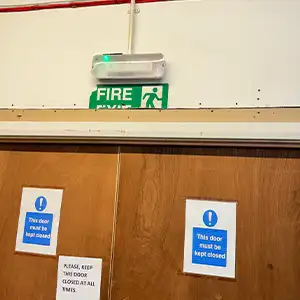
During a recent Fire Risk Assessment at a single‑family residence, the property featured an open‑plan kitchen connected to a smaller secondary kitchen at the rear. Although the main kitchen did not open directly onto the escape route, both cooking areas contained ignition sources and shared ventilation paths. The assessment identified that the absence of a fire‑resisting door between these two kitchens increased the potential for rapid smoke and heat transfer in the event of a fire.
To mitigate this risk, an FD30 fire door was recommended between the small kitchen and the open kitchen. This measure ensures 30‑minute compartmentation, preventing early smoke spread and protecting internal circulation spaces. The recommendation aligns with BS 9991 and Approved Document B, demonstrating how domestic layouts — even in non‑HMO properties — require thoughtful fire separation to maintain safe escape conditions.
Responsibilities Under the Fire Safety Order (FSO 2005)
Under the Fire Safety Order, the Responsible Person (landlord, business owner, employer, or managing agent) must ensure the premises is safe from fire. This includes:
Carrying out a suitable and sufficient Fire Risk Assessment
Acting on significant findings within a reasonable timeframe
Maintaining fire alarms, emergency lighting, extinguishers, and fire doors
Keeping escape routes clear and usable at all times
Recording and reviewing fire safety checks regularly
🔥 Additional Compliance Documents We Check
During a Fire Risk Assessment, we also review key compliance certificates to ensure the building meets legal and safety requirements. These documents help confirm that essential life‑safety systems are being maintained correctly.
Here is the list you should include:
✔ Valid Electrical Installation Condition Report (EICR)
We check whether the property has a current EICR and whether any C1/C2 issues have been addressed.
✔ Fire Alarm Servicing Certificate
We verify that the fire alarm system has been tested and serviced in accordance with BS 5839.
✔ Emergency Lighting Test Certificate
We check that monthly and annual emergency lighting tests are being carried out and recorded.
✔ Fire Extinguisher Service Certificate
We confirm extinguishers have been serviced annually and are suitable for the risk areas.
✔ PAT Testing Records (Portable Appliance Testing)
We check whether portable appliances have been tested and labelled where required.
✔ Fire Door Inspection Records
We review any available fire door inspection reports or maintenance logs.
✔ Gas Safety Certificate (CP12)
For rented properties, we check that a valid CP12 is in place (not part of the FRA, but relevant to overall compliance).
✔ Fire Safety Logbook
We check whether the building maintains a logbook with all required weekly/monthly checks.
✔ Previous Fire Risk Assessment
We review the last FRA to ensure actions have been completed and risks have not increased.
All inspections follow official NRLA Fire safety in Rental Property for Landlords
You can read more on Link Below
How We Carry Out Your Fire Risk Assessment
Our Fire Risk Assessments follow a structured, professional methodology to ensure every hazard is identified, evaluated, and documented clearly. Each assessment is carried out in line with the Regulatory Reform (Fire Safety) Order 2005 and recognised industry best practice.
1. Initial Consultation & Site Overview
We begin by understanding the type of premises, occupancy, activities, and any known concerns. This helps us identify high‑risk areas before the inspection starts.
2. Full Walk‑Through Inspection
We carry out a systematic inspection of the entire building, including:
escape routes and final exits
electrical intake cupboards
kitchens and high‑risk rooms
fire doors and compartmentation
fire alarm and emergency lighting systems
storage areas and plant rooms
gas and electrical services
3. Identification of Hazards & People at Risk
We identify:
ignition sources
fuel sources
oxygen sources
vulnerable persons (staff, residents, visitors, contractors)
This forms the basis of your risk evaluation.
4. Evaluation of Existing Fire Safety Measures
We assess whether your current measures are adequate, including:
fire detection and warning systems
emergency lighting
fire extinguishers
signage
fire doors
maintenance records
housekeeping and storage practices
5. Risk Rating & Prioritisation
Each hazard is given a risk rating based on likelihood and severity. This helps you understand which issues require urgent action.
6. Recommendations & Action Plan
We provide clear, practical recommendations that are:
prioritised
easy to understand
tailored to your premises
compliant with relevant standards
7. Final Report Issued Within 24 Hours
Your FRA report includes:
findings
photos
risk ratings
recommended actions
compliance observations
legal responsibilities
This ensures you have everything needed to improve safety and demonstrate compliance.
Why an Electrical-First Approach to Fire Risk Assessments Matters?
1. Identifying Invisible Ignition Risks
- Overloaded Circuits: Spotting dangerous setups, such as too many high-draw appliances plugged into a single extension lead.
- Degraded Infrastructure: Identifying scorched or burned sockets and dangerously undersized cables that overheat under normal building loads.
- Containment Failures: Checking for non-fire-rated cable clips that cause wiring to collapse and trap occupants or firefighters during an evacuation.
- Dangerous Consumer Unit Placement: Evaluating plastic or non-fire-rated fuse boards installed directly within critical fire escape routes.
2. Expert Diagnostics of Life-Safety Systems
- Hidden Panel Faults: Reading and diagnosing complex system errors, such as disabled sounders or unaddressed wiring faults.
- Compromised Coverage: Pinpointing missing or disabled safety devices that have been improperly removed from the loop.
- Incorrect Sensor Profiles: Identifying the wrong type of detectors installed in a space (e.g., using a standard smoke detector where a heat detector is required, leading to false alarms or delayed activation).
Risk Scoring – How We Prioritise Fire Safety Hazards
High Risk (Immediate Action Required)
High likelihood of fire
High severity if a fire occurs
Must be addressed immediately
Examples:
No fire detection in high‑risk electrical areas
Blocked escape routes
Faulty fire alarm systems
Medium Risk (Action Required Soon)
Moderate likelihood or severity
Should be addressed within a reasonable timeframe
Examples:
Damaged fire doors
Missing signage
Poor housekeeping
Low Risk (Monitor & Maintain)
Low likelihood and low severity
No urgent action required
Examples:
Minor storage issues
Small improvements to lighting or signage
We use a simple and transparent risk scoring system to help you understand which hazards require urgent action and which can be monitored over time.
Frequently Asked Questions
How often do I need a Fire Risk Assessment for my London property?
Under the Regulatory Reform (Fire Safety) Order 2005, a Fire Risk Assessment must be kept up-to-date. While the law doesn’t specify a strict calendar timeframe, industry best practices dictate reviewing your assessment annually and conducting a full new assessment every 2 to 3 years, or immediately if structural alterations are made to the building.
Do HMO landlords in London legally require a professional FRA?
Yes. If you own or manage a House in Multiple Occupation (HMO) or a purpose-built block of flats, you are legally responsible for the communal areas (hallways, stairwells, main entrance doors). Failing to provide a valid FRA can result in severe financial penalties from local London councils.
What is checked during an Eco Tech Fire Risk Assessment?
We conduct a comprehensive survey covering escape routes, emergency lighting functionality, fire alarm panels, fire door integrity, and structural compartmentation. Uniquely, our electrical contracting background allows us to meticulously evaluate your EICR status to identify hidden electrical ignition hazards.
How much time do I have to complete any remedial work found in the assessment?
- Immediate Action: Critical safety breaches (e.g., blocked fire exits or major electrical ignition hazards) must be resolved right away.
- High Risk (1 to 4 weeks): Urgent items that compromise your safety systems, such as broken emergency lighting or non-compliant fire doors.
- Medium to Low Risk (Up to 3 months): Minor compliance improvements or long-term structural maintenance tasks.
Do I really need to keep and maintain a physical Fire Log Book?
Yes, legally you must. Under UK fire safety regulations, you are required to keep a continuous, verifiable record of all your safety checks—including weekly fire alarm tests, monthly emergency lighting checks, and annual extinguisher services. If a local council inspector or London Fire Brigade officer visits your premises, the Fire Log Book is the very first thing they will ask to see.
What if I don't have a Fire Log Book or don't know how to fill it out?
Don’t worry, we do not leave you to figure it out on your own. If you do not have one, we will provide a complete Fire Log Book for your property. More importantly, before we leave your site, we will sit down with you and explain exactly how to maintain it, what to test, and how to log your findings. Keeping this book properly updated is your legal shield if an incident ever occurs.
Written by: Shashi Pal, AIFSM
Position: NICEIC Approved QS
Qualification: JIB Gold Card
Professional Membership:
Associate Member – IFSM (8946)
Last updated: 09 July 2026
Fire Safety Legislation:
Regulatory Reform (Fire Safety) Order 2005
Fire Safety Act 2021
Fire Safety (England) Regulations 2022
Safety Disclaimer:
Fire Risk Assessments must only be carried out by competent and suitably qualified assessors in accordance with the Regulatory Reform (Fire Safety) Order 2005. The information on this page is provided for general guidance and should not be relied upon as a substitute for a formal FRA. For accurate advice specific to your premises, please consult a certified fire risk assessor or arrange a professional assessment.
Fire Risk Assessments are carried out by our qualified and competent fire‑safety assessor.