

TT earthing case study / IG11, Barking
A new TT earth after a defective supply earth stopped an EV charger connection
The charger installer would not energise the equipment after a supply earthing concern. We installed an earth electrode and new earthing route, upgraded the consumer unit's RCDs and certified the electrical work.
Project photograph: main earthing connection at the intake.
- LocationIG11, Barking
- Why we were calledEV charger left unenergised after a supply earth concern
- Supply arrangementExisting looped supply to the neighbouring property
- Work completedTT electrode, 16 mm² earthing conductor and Type A RCDs
- HandoverElectrical Installation Certificate
On site / TT earth electrode installation
Why this EV charger project needed a new earthing arrangement
A homeowner in IG11, Barking had bought an electric car and arranged a charger installation through Octopus Energy. The charger installer declined to energise the equipment because of a concern about the existing supply earth. UK Power Networks (UKPN) subsequently attended and recorded a defective supply earthing connection. This case study follows the separate TT earthing work we carried out at the property; it does not claim that we installed or commissioned the EV charger.
The call, the visit and the UKPN finding
The customer contacted us on a Saturday evening. Although our administration team had finished for the day, we were monitoring the business WhatsApp for urgent enquiries. This was not an emergency call-out, but we spoke with the homeowner and arranged to inspect the property on Sunday.
The customer explained that the charger installer had raised an issue with the existing earthing arrangement. According to the UKPN report shared for this job, a reading of 1.01 Ω was recorded at an unapproved connector associated with the supply earth. UKPN described the supply earth as defective and advised that an electrician fit a TT system; the connector was not accepted as UKPN's responsibility. That figure describes the reported existing connection, not the resistance of the new earth electrode.
After the survey we agreed a price, ordered the required parts from a local electrical wholesaler and planned an earthing route with the homeowner.


What we found before fitting the earth rod
The incoming supply was looped to the neighbouring property. The neighbour's installation was inaccessible and outside our agreed scope. We did not disconnect or alter the onward loop; UKPN was aware of the arrangement. The new TT electrode was for our customer's installation, not a claim to have corrected or provided earthing for next door.
At the consumer unit, we found existing Type AC RCDs. For the planned TT arrangement, we selected replacement Axiom Type A RCDs as part of the protective-device review. In a TT installation the fault current may be too low for an MCB alone to achieve the required disconnection; correct RCD selection and verified operation are essential. Type A was chosen in place of the existing Type AC devices, with suitability assessed for this installation rather than assumed from the label alone.
The existing 16 mm² meter tails ran behind the wooden board supporting the meter. We replaced these with 25 mm² tails routed visibly on the surface through a 32 mm bush and locknut, so the concealed run behind the board was removed. We labelled the old supply earthing point "Defective UKPN Earthing - Do Not Use".


The 16 mm² earthing route, from the intake to the garden
We agreed the route with the customer before starting. The main intake and consumer unit were in the under-stairs cupboard. From there, the 16 mm² earthing conductor passed through the adjacent cupboard containing the washing machine and tumble dryer, where we used surface trunking with metal fire-rated cable supports.
The route continued below the kitchen units. Space behind the plinth was too restricted to clip the conductor in the usual way, so we enclosed that section in 20 mm black PVC conduit. It then passed out to the garden. The wall openings made for the route were filled after the cable was installed.
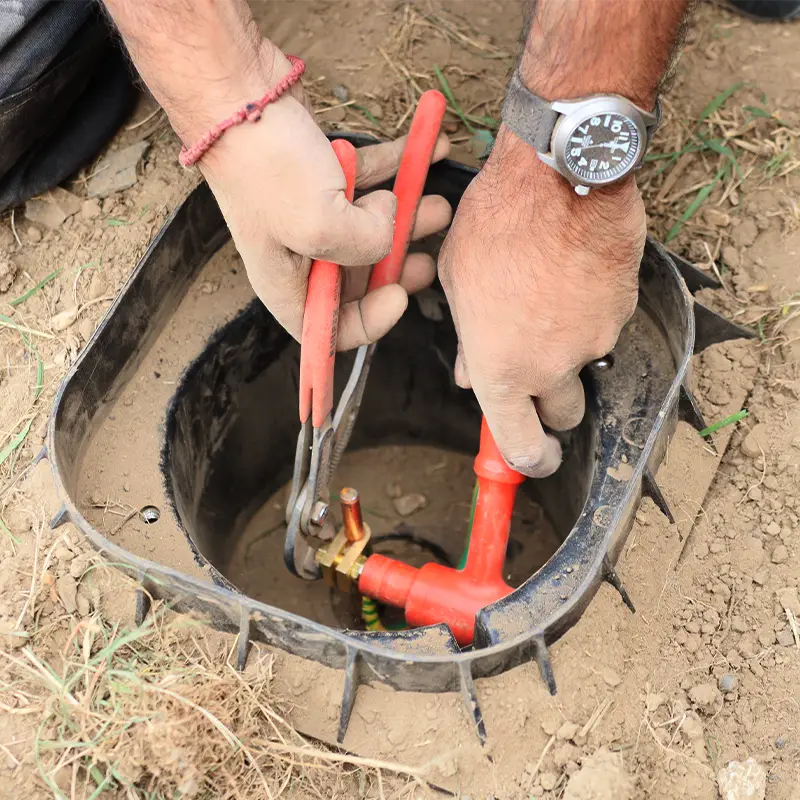
Outside, 20 mm PVC conduit and a one-way conduit box carried the cable along the concrete blocks beneath the fence, secured using spacer bars and saddles. At the earth inspection chamber, we crimped a 16 mm² lug with an 8 mm hole and secured it to a 3/8-inch diameter, four-foot earth rod. The conductor was then connected to the main earthing terminal (MET) inside.



Test readings and what they do, and do not, show
We recorded an electrode resistance of 162 Ω during testing. Soil moisture and seasonal conditions can affect this figure. The reading was below 200 Ω, but 200 Ω is not a universal pass/fail limit: the design also depends on the RCD's rated residual operating current, the required touch-voltage limit, reliable operation and the applicable BS 7671 requirements. The measured electrode resistance must be considered separately from other paths to earth.
After connecting the earthing conductor to the MET, we measured 9.30 Ω at the board. That lower reading can reflect parallel earth paths through connected services and the installation. It must not be substituted for the electrode-only Ra value when evaluating the TT electrode. We replaced the RCDs with Type A units, retested the installation and issued an Electrical Installation Certificate (EIC) together with the Part P certificate for the work.
Scope boundary: the neighbouring looped supply was left as found, and the original UKPN earth was labelled not to be used. Charger energisation and the neighbour's earthing arrangements are not outcomes claimed by this case study.


Watch the earthing installation
See the project footage alongside the photographs and recorded test results above.
The customer's experience
"I had been looking for a certified electrician to install a TT system, as advised by UK Power Networks. I posted the job on MyBuilder and Bark but unfortunately wasn't having much luck finding someone with the right experience.
The whole process became quite stressful, so I decided to ask ChatGPT for help. I was genuinely impressed with how it helped me find local electricians and identify professionals with experience in this type of work. It also recommended that I contact them directly first to explain exactly what I needed.
I left a message and was relieved to hear back from someone who could actually carry out this type of installation. I specifically requested certification upon completion, and they had no hesitation in confirming that the appropriate certificate would be provided at the end of the job.
I was also impressed with how quickly they responded. They came out the very next day to inspect the installation. The engineer explained all the available options, answered my questions and was very helpful and professional throughout.
We agreed on a date for the work, and he turned up exactly as arranged. The job was completed neatly and tidily, even though the working space was quite restricted.
It's genuinely nice to find a reliable, professional electrician nearby who knows what they're doing and takes pride in their work. I'm very happy with the service and would definitely recommend them to anyone looking for an electrician experienced with this type of work."
Questions about TT earthing after an EV charger refusal
What is a TT earthing system?
In a TT arrangement, the installation uses its own earth electrode as the connection to earth rather than relying on a distributor-provided earth terminal. A qualified electrician must design the protective measures, including appropriate RCDs, and verify them by testing.
Does a 162 Ω earth rod reading automatically pass?
No. Electrode resistance is only part of the assessment. RCD ratings and operation, touch-voltage and disconnection requirements, test conditions and the complete installation all matter. Parallel paths can also make a later loop reading look lower than the electrode-only measurement.
Why were the Type AC RCDs changed?
The existing board had Type AC devices. As part of this TT installation, we selected Type A RCDs and tested the installation. The appropriate device type and rating must always be selected for the circuits and equipment actually installed.
Did this work include the neighbouring supply or the EV charger?
No. We left the existing looped supply to next door untouched. The work described here was the earthing and related installation changes at our customer's property; we do not claim to have energised or certified the EV charger.
What paperwork did the customer receive?
We issued an Electrical Installation Certificate (EIC) and a Part P certificate for the completed work.
Need an electrician to assess a supply earthing problem?
Tell us what the network operator or charger installer has reported, and share any existing report and a photo of the intake. We can discuss a site assessment and the work needed for your particular installation.
Call 020 3633 5557 WhatsApp +44 7777 114310