Eco Tech Electrical Contractors limited

Skip to content

EICR London · Landlord safety certificates

Landlord Safety EICR Certificates in London

NICEIC approved electrical inspections for landlords, homeowners and businesses. Fast turnarounds, clear reports and same-day appointments available across London postcodes.

  • From £85.99 for communal EICR inspections
  • Domestic EICR options from £89.99
  • Pay after inspection
  • Certificate delivered within 24 hours

Clear fixed pricing · Qualified inspection · No hidden charges

Studio Flat

£89.99*

All Inclusive (No Hidden Charges)

BOOK NOW02036335557

1-2 Bedroom

£89.99*

All Inclusive (No Hidden Charges)

BOOK NOW02036335557

3-4 Bedroom

£99.99*

All Inclusive (No Hidden Charges)

BOOK NOW02036335557

5-6 Bedroom

£110.99*

All Inclusive (No Hidden Charges)

BOOK NOW02036335557

Communal EICR

£85.99*

All Inclusive (No Hidden Charges)

BOOK NOW02036335557

Large or Complex Buildings

Speak to Our Engineer for a Free, Accurate Quote

02036335557
* Parking charges are applicable in case of paid parking.
*£18 Congestion Charge applicable in case the property is in congestion charge zone
4.9
65 Reviews
google
Tamara Abood
Tamara Abood
5.0
28/10/2026
google
Tarciziu Erdes
Tarciziu Erdes
5.0
27/10/2026
google
Max Montane-Willis
Max Montane-Willis
5.0
27/10/2026
google
Jan Du
Jan Du
5.0
16/10/2026
google
DG Family
DG Family
5.0
06/10/2026
google
Narojan Amirthalingam
5.0
29/09/2026
google
Foisal
Foisal
5.0
24/09/2026
google
fariba mavaddat
fariba mavaddat
5.0
20/09/2026
google
Graham Storey
Graham Storey
5.0
09/09/2026
google
Amy
Amy
5.0
08/09/2026
google
Ionut Bilibou
Ionut Bilibou
5.0
08/09/2026
google
Chaitanya Joshi
Chaitanya Joshi
5.0
07/09/2026
google
Nate n
Nate n
5.0
28/08/2026
google
iirth events
iirth events
5.0
27/07/2026
google
Lily Liu
Lily Liu
5.0
25/07/2026

A safer choice for your property

Why Choose Us for Your EICR?

Your electrical safety report should be clear, properly tested and carried out by someone you can trust. Here is what you get with Eco Tech Electrical.

Built around safe, honest inspections

Confidence from the first test to the final report.

  • NICEIC Approved Contractor with qualified electrical expertise
  • BS 7671 aligned inspections for domestic and rental properties
  • Clear findings explained without confusing technical language
  • Fixed, transparent pricing before the inspection begins
  • Landlord-ready documentation for tenant and compliance records
  • Fast appointments across London, with certificates issued promptly
Professional inspection. Straight answers. No pressure.
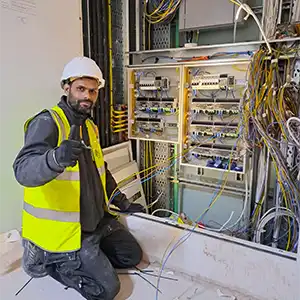
Shashi Pal, NICEIC Approved Qualified Supervisor and electrician
Real on-site electrical testingConsumer units, circuits and safety systems checked carefully.

Need a clear answer about your installation?

Book online in minutes or speak directly to a qualified electrician.

Simple from booking to certificate

Fast & Hassle-Free EICR Process

No confusing steps and no unnecessary delays. Choose a convenient appointment, let a qualified engineer complete the inspection, then receive your report digitally.

STEP 01

Book online or call us

Choose the appointment time that works best for you and your property.

STEP 02

Engineer completes inspection

A qualified and insured NICEIC engineer carries out the full EICR.

STEP 03

Pay after inspection

No upfront fees. Pay only once the inspection has been completed.

STEP 04

Receive your certificate

Your digital EICR report is delivered by email within 24 hours.

From inspection complete to certificate delivered Our digital reporting process is designed to get your EICR to you in under 24 hours.
Testing doneInvoice sendingPayment confirmationCertificate released
Certificate delivered within 24 hours

Clear process. Qualified inspection. No payment before the visit.

Need help choosing the right appointment? Speak directly to our team before booking.

📍Areas We Cover

Electrical and fire safety compliance across all 30 London boroughs.

  • Barking & Dagenham
  • Barnet
  • Bexley
  • Brent
  • Bromley
  • Camden
  • Croydon
  • Ealing
  • Greenwich
  • Hackney
  • Hammersmith & Fulham
  • Haringey
  • Harrow
  • Havering
  • Hillingdon
  • Hounslow
  • Islington
  • Kensington & Chelsea
  • Kingston upon Thames
  • Lambeth
  • Lewisham
  • Merton
  • Newham
  • Redbridge
  • Richmond upon Thames
  • Southwark
  • Sutton
  • Tower Hamlets
  • Waltham Forest
  • Westminster

We also cover nearby areas outside London — contact us to confirm.

Behind every clear EICR certificate

What We Check During an EICR

Explore the inspection journey: from circuit testing and socket polarity to consumer units, RCD protection, earthing and bonding.

Burnt socket discovered during an EICR inspection
01Inspection stage

Visual inspection of accessories

We look for damage, overheating, loose connections and signs that could make an installation unsafe.

Follow the inspection

Select a check to see the evidence.

Auto-play

Important: these images show only a selection of EICR checks. Every installation is different, and additional tests may be required to assess compliance with BS 7671.

Important: these images show only a selection of EICR checks. Every installation is different, and additional tests may be required to assess compliance with BS 7671.

See electrical testing in action

A closer look at professional EICR testing

Watch this short vertical video to see the care and attention that goes into inspecting an electrical installation and producing a clear EICR report.

  • Qualified electrical inspection
  • Testing explained clearly
  • Professional approach from inspection to certificate

Vertical EICR inspection video

Landlord Update

Landlords: New BS 7671 Regulations — What You Must Know

Several faults that used to pass an inspection are now coded C2 (Fail). If your property is an HMO, has a TT earthing system or a Grade A fire alarm panel, the rules that apply to you have changed.

  • Type AC RCDs no longer acceptable in high-risk buildings
  • TT earthing with a Type AC RCD is an automatic C2
  • AFDDs now mandatory in HMOs and care homes
  • Missing SPD on a Grade A fire alarm system is a C2
  • Plastic consumer units in escape routes can now fail
  • HMOs need a different inspection standard to normal homes
Read the landlord guide

Free to read · Written by an NICEIC Approved QS

A complete electrical safety check

What’s Included in Your EICR?

A proper EICR looks beyond a quick visual check. We inspect the installation, test accessible circuits and explain exactly what the findings mean for your property.

01

Full visual inspection

We check sockets, switches, fittings, the consumer unit, visible wiring and the overall condition of the installation.

02

Consumer unit inspection

We check protective devices, RCD operation, circuit labelling and the safety of the distribution board.

03

Testing of all circuits

Continuity, insulation resistance, polarity, RCD testing and fault detection are carried out where accessible.

04

C1, C2 and C3 identification

Defects are classified clearly so landlords and homeowners know what is dangerous, what needs fixing and what is advisory.

05

Earthing and bonding verification

We confirm that main earth bonding to gas, water and structural metalwork is present and compliant.

06

Digital report and recommendations

You receive a clear, professional NICEIC-approved report by email with practical next steps.

For commercial sites, we also provide Commercial EICR inspections tailored to offices, warehouses and retail units. If faults are found, our fault-finding electrician service can diagnose and repair the issue.

Book Your EICR
Simple online booking

Book your EICR online in three simple steps.

Choose your property size, see the fixed price instantly, select a convenient appointment, and secure your booking online.

Choose your property size

Select your property type and see the fixed price immediately.

Pick your date and time

Choose an appointment slot that works for you or your tenant.

Secure your booking

Confirm your appointment online. No upfront payment is required.

Fast, clear, convenient

Book your EICR online.

See your price before you book and pay after the inspection.

Book Your EICR Now


All inspections & installations follow official NICEIC safety standards.


Read more on the NICEIC website

Not Sure What You Need?

Tell us about the property and we’ll advise which inspection or certificate applies.


Speak to a NICEIC Approved Electrician

Explore Our Compliance Case Studies

Real-world inspections, upgrades, and risk assessments completed across London.


View Case Studies

EICR London guidance from a NICEIC approved contractor

EICR Explained: Your Guide to Electrical Safety Certificates in London

Looking for an EICR certificate, an electrical safety certificate in London or EICR testing near you? This guide explains the inspection, legal responsibilities, likely findings and next steps for landlords, homeowners, managing agents and commercial property owners.

What Is an EICR?

An EICR is a formal inspection and testing report prepared by a qualified and competent electrician. EICR testing assesses whether an existing installation is safe for continued use and identifies damage, deterioration, defects, unsafe alterations and departures from the applicable standard.

The report records observations using the recognised C1, C2, C3 and FI classification system, helping you understand what requires urgent attention, remedial work or future improvement.

  • Visual inspection: sockets, switches, accessories, consumer unit and visible wiring.
  • Electrical testing: continuity, insulation resistance, polarity, earthing and RCD operation.
  • Clear outcome: a professional report with observations and practical recommendations.

What Is BS 7671?

BS 7671, commonly known as the IET Wiring Regulations, is a non-statutory technical standard used across the UK for the design, installation, inspection and testing of electrical installations. It is not an Act of Parliament, but it is the recognised benchmark used by competent electricians, inspectors, insurers and courts when electrical safety is assessed.

An EICR certificate records the condition of the installation against the relevant requirements of BS 7671 at the time of inspection. Following the standard helps demonstrate that the inspection and any recommendations have been approached competently.

  • Design: whether the installation is suitably arranged.
  • Protection: whether people and property are protected from electrical danger.
  • Inspection and testing: whether accessible circuits and equipment perform safely.

What Is EAWR?

The Electricity at Work Regulations 1989 are statutory regulations. They require electrical systems in workplaces to be constructed, maintained and operated so they do not create danger. They are especially relevant to employers, duty holders, commercial property owners and people responsible for workplace premises.

An EICR can form part of a wider electrical maintenance and compliance programme, but it does not replace the responsible person’s legal duty to manage electrical risks between inspections.

Landlord EICR Responsibilities

For private rented properties in England, landlords must arrange an electrical safety inspection at least every five years, or sooner where the report requires it. This is why landlords search for a reliable electrical certificate and EICR service in London. They must also:

  • Give tenants the required copy of the report.
  • Provide the local authority with a copy within 7 days when requested.
  • Complete required remedial work or further investigation within the stated timeframe.
  • Use a qualified and competent electrician for the inspection and remedial work.

These electrical certs for landlords should be kept with the property records. Landlords may also need regular fire alarm testing and, depending on the property and equipment, PAT testing.

What Happens After an EICR?

Your electrician will explain the report, identify any observations and tell you which actions matter most. A clear report should help you make a sensible decision, not leave you guessing.

  • Satisfactory report: keep the certificate with your property records and follow the recommended inspection interval.
  • Further work needed: arrange qualified remedial work or investigation within the timeframe stated in the report.
  • After repairs: retain the written confirmation, updated certificate or relevant certification for your compliance records.

Where faults are found, our electrical fault-finding and repair service can help diagnose the issue and plan the next step.

Why Choose a NICEIC Approved Contractor?

NICEIC approval shows that a contractor has been assessed against relevant technical and operational requirements. It gives clients an additional way to check that their electrician works within a recognised assessment scheme.

We are NICEIC approved contractors carrying out professional EICR testing and electrical safety inspections for landlords, homeowners and businesses across London. Maintaining that approval means working through ongoing scheme checks, including annual technical assessment or audit requirements and continuing professional development to keep our knowledge current.

That matters to you because the process encourages documented, current and accountable workmanship. We inspect the accessible installation carefully, explain the findings clearly and provide the certificate or report you need for your records rather than taking shortcuts.

  • Qualified and competent electrical inspection.
  • Clear reporting for landlords and managing agents.
  • Practical guidance when remedial work is identified.

Need an EICR for a rental, home or commercial property?

EICR certificate cost depends on the property size, number of circuits and access. Book an inspection online or speak to a qualified electrician about your electrical testing requirements.

Understand your electrical safety report

EICR Codes Explained: C1, C2, C3 and FI

These observation codes explain what an electrician has found during an EICR inspection and what action may be needed next. The final outcome depends on the observations recorded in the report.

C1 Code

Danger present

A C1 observation indicates an active and immediate danger, such as a serious risk of electric shock or fire. The affected circuit or equipment may not be safe to use.

Required action

Make the danger safe without delay through urgent work by a qualified electrician.

C2 Code

Potentially dangerous

A C2 observation identifies a fault that is not immediately dangerous but could become hazardous if it is left unaddressed.

Required action

Arrange suitable remedial work as soon as reasonably possible to remove the risk.

C3 Code

Improvement recommended

A C3 observation highlights an aspect of the installation that is not considered dangerous, but could be improved for safety, reliability or future compliance.

Recommended action

Plan the improvement when convenient and consider it alongside other electrical work.

FI Code

Further investigation required

An FI observation means part of the installation could not be fully inspected or a concern needs deeper examination before a conclusion can be reached.

Required action

Arrange further investigation so hidden faults can be identified and dealt with properly.

Received a C1, C2 or FI observation?

Our qualified electricians can explain the finding, investigate the cause and discuss the most sensible next step.

NICEIC Approved Contractor · London Residential Safety

Domestic & HMO EICR Testing in London

At Property Cert Experts, we provide fully compliant Domestic EICR and HMO Electrical Safety Certificates for landlords, homeowners, letting agents, and property managers across all London postcodes. Whether you own a single dwelling flat or manage a portfolio of multi-occupancy HMO properties, our NICEIC-approved electrical inspections ensure your installation is safe, certified, and compliant with all statutory regulations.

HMO Licensing & Landlord Regulations

Under the Electrical Safety Standards in the Private Rented Sector (England) Regulations 2020, landlords must ensure electrical installations are inspected at least every 5 years by a qualified electrician.

For Houses in Multiple Occupation (HMOs), local council licensing conditions are even stricter. Councils require a valid 'Satisfactory' EICR alongside fire alarm and emergency lighting certificates before granting or renewing HMO licences.

  • Mandatory 5-Year Cycle: Landlords must supply a copy of the EICR to tenants within 28 days of inspection.
  • HMO Licence Compliance: Satisfies council property licensing, planning conditions, and HMO management regulations.
  • 28-Day Remedial Rule: Any C1, C2, or FI observations require remedial action within 28 days (or sooner if specified).

What Our Domestic & HMO EICR Covers

Our comprehensive testing strictly follows BS 7671 (18th Edition Wiring Regulations) to verify that all electrical components and fixed circuits perform safely:

  • Consumer Units & Fuse Boards: Testing of main switches, circuit breakers, RCDs, and surge protection.
  • Fixed Wiring & Circuit Integrity: Insulation resistance, continuity, earth loop impedance, and polarity checks.
  • Earthing & Bonding: Main protective bonding verification to incoming gas, water, and structural services.
  • Sockets, Switches & Luminaires: Inspection of all light fittings, switch plates, sockets, and fixed appliances.
  • Clear Defect Coding: Transparent classification of C1 (Danger Present), C2 (Potentially Dangerous), C3, and FI codes.

Who Needs a Domestic or HMO EICR in London?

Our NICEIC-approved electricians provide prompt inspection appointments across all London boroughs for:

Private Landlords Single buy-to-let flats, rental houses, and change of tenancy checks.
HMO Property Landlords Bedsits, shared houses, student lets, and multi-storey licensable HMOs.
Homeowners & Buyers Property purchases, pre-sale surveys, older home assessments, and rewires.
Estate & Letting Agents Portfolio management, compliance tracking, and automated key collection.
Housing Associations Social housing blocks, communal areas, and residential property trusts.

How Often Should a Domestic or HMO EICR Be Carried Out?

Statutory and recommended electrical inspection frequencies across residential properties in the UK:

Property Type / Circumstance Frequency Legal Status & Compliance Notes
Private Rented Homes (Single Tenancies) Every 5 Years Legal Requirement: Mandatory under PRS Regulations 2020.
Houses in Multiple Occupation (HMOs) Every 5 Years Legal Requirement: Mandatory for HMO licence application & renewal.
Owner-Occupied Domestic Properties Every 10 Years Recommended benchmark under BS 7671 for home safety & insurance.
Change of Tenancy Each New Tenancy Strongly recommended to ensure safety between incoming tenants.
After Major Electrical Alterations or Rewiring Upon Completion Accompanied by an Electrical Installation Certificate (EIC).

Common Reasons Domestic & HMO Properties Fail an EICR

Our engineers identify hazards early to protect occupants and keep properties compliant. The most frequent issues causing an 'Unsatisfactory' report include:

Outdated Consumer Units: Wooden-backed fuse boards lacking 30mA RCD protection.
Deteriorated or Old Wiring: Degraded lead or vulcanised rubber insulated cabling.
Missing Earthing & Bonding: Disconnected or undersized main protective bonding to gas and water.
Overloaded Circuits & Damaged Accessories: Cracked sockets, loose connections, or melted fittings.
DIY & Uncertified Alterations: Unsafe modifications without proper testing or containment.
Thermal & Fire Risks: Loose screw terminals causing overheating inside consumer units.

Book Your Domestic or HMO EICR Online Today

NICEIC approved contractors, transparent fixed rates from £89.99, and official 24-hour digital certificate delivery. Pay after inspection.

020 3633 5557

EICR advice for London properties

EICR London – Frequently Asked Questions

Clear answers for landlords, homeowners and property managers before booking an Electrical Installation Condition Report.

BS 7671 alignedQualified electrical inspection
Landlord readyUseful for rental compliance
Clear reportingFindings explained simply

Landlord and rental property FAQs

01Is an EICR a legal requirement in London?

Yes for properties in the private rented sector. Under the Electrical Safety Standards in the Private Rented Sector (England) Regulations 2020, landlords must have an EICR carried out at least every 5 years, or sooner if the report recommends it.

  • Give a copy to new tenants before they move in.
  • Give a copy to existing tenants within 28 days.
  • Provide a copy to the local authority within 7 days if requested.

For homeowners, an EICR is not generally a legal requirement, but it is strongly recommended every 10 years or before selling a property.

02How often does an EICR need to be done?

The interval depends on the property and the previous report. Typical guidance is 5 years for landlords and HMOs, 10 years for homeowners, and often 5 years for commercial properties. If the previous report recommends 1 or 3 years, follow that shorter interval.

03Is an EICR required for HMOs and rental properties?

Yes. HMOs and private rental properties should have a valid EICR on the required schedule, with remedial work completed within the timeframe stated in the report. Keep proof of compliance available for tenants and the local authority.

04How long do landlords have to fix issues after an unsatisfactory EICR?

Remedial work must normally be completed within 28 days, or sooner if the report specifies a more urgent timeframe. Written confirmation of completion should then be provided to the tenant and local authority where required.

Inspection, cost and timing FAQs

05What does an EICR check and what is included?

An EICR assesses the safety and condition of an existing electrical installation. It can include checks of the consumer unit, RCD protection, earthing and bonding, sockets, switches, lighting circuits and accessible cables, plus testing for continuity, insulation resistance, polarity and earth loop impedance.

06How long does an EICR take to complete?

Timing depends on the property size, number of circuits, access and installation condition. A 1-bedroom flat may take around 45 minutes to 2 hours; a 2-bedroom flat around 1.5 to 2.5 hours; larger or older properties can take 3 hours or more. Additional testing may increase the time.

07How much does an EICR cost in London?

The price depends on the property size, number of circuits, age of the installation and access to the consumer unit and sockets. Smaller flats usually take less time, while larger or older properties may need more detailed testing. Use the live booking option above for current pricing.

08Do I need an EICR to sell or buy a house?

It is not usually a legal requirement for a sale, but solicitors, surveyors, mortgage lenders and buyers may request one. A recent EICR can identify electrical issues early and give buyers greater confidence, especially where the installation is more than 10 years old.

Understanding your EICR report

09What are EICR codes C1, C2, C3 and FI?
  • C1 - Danger present: immediate risk requiring urgent action.
  • C2 - Potentially dangerous: remedial work is required.
  • C3 - Improvement recommended: not dangerous, but an improvement is advised.
  • FI - Further investigation: more testing is needed before a conclusion can be reached.

C1, C2 or FI observations generally make the report unsatisfactory. C3 observations alone do not normally make an EICR unsatisfactory.

10What happens if my property fails the EICR?

The report will identify the observations that need attention. A qualified electrician can explain the findings, quote for remedial work and issue written confirmation once the work is complete. You do not normally need a full new EICR if the required remedial work and confirmation have been completed.

11What causes an EICR to fail?

Common causes include exposed live parts, damaged accessories, lack of RCD protection, deteriorated wiring, missing earthing or bonding, overloaded circuits, incorrect polarity, high earth loop impedance, failed insulation resistance or unsafe DIY electrical work.

12What tests are carried out during an EICR?

A qualified electrician may carry out continuity testing, insulation resistance testing, polarity testing, earth loop impedance testing and RCD testing, alongside a visual inspection of accessible components and circuits.

13What is the difference between an EICR, EIC and Minor Works Certificate?

EICR: inspection and testing of an existing installation. EIC: certification for a new installation, consumer unit replacement or major rewire. Minor Works Certificate: certification for smaller additions or alterations. They are not interchangeable.

14How long is an EICR valid for landlords and homeowners?

For landlords, the usual maximum interval is 5 years, subject to the report and applicable requirements. For homeowners, 10 years is commonly recommended. Commercial properties often use a 5-year interval. Always follow a shorter interval stated by the inspecting electrician.

Ready to arrange your EICR?

Check the current price online or speak to a qualified electrician about your property.

Book Your EICR

Written & reviewed by

Written by:
Shashi Pal
Position:
NICEIC Approved QS
Qualification:
JIB Gold Card
Professional Membership:
Associate Member - IFSM (8946)

Last updated: 09 September 2026

Regulation References

  • ElectricalBS 7671:2018 + A4:2026 (IET Wiring Regulations)
  • Workplace safetyElectricity at Work Regulations 1989 (where applicable)
  • Private rented sectorElectrical Safety Standards in the Private Rented Sector (England) Regulations 2020

Safety Disclaimer:

Electrical installations must only be inspected, tested, or certified by qualified and competent persons. An Electrical Installation Condition Report (EICR) is carried out in accordance with BS 7671 and the relevant electrical safety requirements for the property.

The information on this page is provided for general guidance and should not be used as a substitute for a professional electrical assessment or an EICR. For accurate advice specific to your property, please consult a qualified electrician or book a formal inspection.